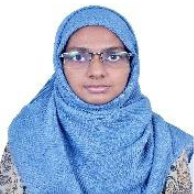
Fahmida Ahmed Antara
Work place: Department of IoT and Robotics Engineering, University of Frontier Technology, Bangladesh, Kaliakair, Gazipur-1750, Bangladesh
E-mail: fahmida0001@uftb.ac.bd
Website: https://orcid.org/0009-0003-0005-1510
Research Interests:
Biography
Fahmida Ahmed Antara has been currently employed as Lecturer in the department of IoT and Robotics Engineering, University of Frontier Technology, Bangladesh from 2023. She pursued the Bachelor in Science in Electrical and Electronic Engineering from Rajshahi University of Engineering and Technology in 2016, Masters in Science in Biomedical Physics and Technology from University of Dhaka in 2021. She has experience of 8 years of teaching and conducting research in different universities. Her research interest includes biomedical signal processing, machine learning and electric vehicle technology.
Author Articles
IoT-Based Smart Homes: Technologies, Security Risks and Countermeasures
By Tanvir Ahmed Akhterujjaman Siddiquee Sheikh Sidratul Muntaha Punno Md. Moshiur Rahman Fahmida Ahmed Antara Sadia Enam
DOI: https://doi.org/10.5815/ijieeb.2026.03.11, Pub. Date: 8 Jun. 2026
The advent of Internet of Things (IoT) technologies has essentially transformed traditional houses into intelligent, equipped, and networked smart houses that serve to improve the quality of life of human beings with respect to security, energy efficiency, and comfort through massive automation, sensing, and remote control. However, such a shift of paradigm, due to the diversity of devices, the limitation of resources, problems of interoperability, and a growing array of cyberthreats, opens up numerous avenues for security and privacy threats. This review attempts a holistic coverage of IoT-based smart home technologies and then provides a systematic classification of the security vulnerabilities from device, network, cloud, and application layers. The key threats include unauthorized access, data leakage, propagation of malware, denial of service, and exploits targeted against AI, with an analysis of their causes and occurrences in the real world. The paper undertakes a critical assessment of contemporary countermeasures, ranging from lightweight cryptographic protocols, AI-driven intrusion detection systems, blockchain-based authentication, privacy-preserving edge computing, and zero-trust frameworks. A comparative insight into each approach compared with the views of the established literature draws out trade-offs between security efficacy, scalability, computational overheads, and user adoption. Based on a synthesis of the modern findings, continued gaps are identified, and future directions provided, including quantum-resistant encryption, interoperable standards, and user-centric security design, acting as the working platform or actionable directions for any researchers, developers, or policymakers in building a secure, resilient, and privacy-preserving smart home ecosystem.
[...] Read more.Quantitative Analysis of Socio-Economic Determinants of Adult Income Using Machine Learning Techniques
By Sabrina Akter Sadia Enam Md. Moshiur Rahman Fahmida Ahmed Antara
DOI: https://doi.org/10.5815/ijieeb.2025.06.01, Pub. Date: 8 Dec. 2025
Income inequality is a persistent issue in both developed and developing economies, influenced by complex socio-economic factors such as education, occupation, and gender. This study addresses a critical gap by applying advanced machine learning techniques to analyze the socio-economic determinants of income in Bangladesh and global contexts. The primary objectives were to identify the most influential factors affecting income and assess the effectiveness of various machine learning models in predicting income levels. Using datasets from Bangladesh and global sources, this study employed Random Forest, Gradient Boosting, Logistic Regression, and Support Vector Machines to predict income and assess feature importance. Key findings showed that education, occupation, gender and hours worked per week were the most significant predictors of income. The Bangladeshi dataset highlighted limited access to higher education and pronounced gender disparities, while the global dataset reflected gender pay gaps and more equitable educational access. Random Forest Classifier appeared as the most effective model, achieving 100% accuracy in Bangladesh and 96% accuracy globally. These findings underscore the need for targeted policies to improve educational access, promote vocational training, and address gender inequality to reduce income disparities. Additionally, the study demonstrates the potential of machine learning to uncover non-linear relationships in socio-economic data, providing valuable insights for evidence-based policymaking. This research highlights the importance of integrating advanced data-driven methods to address the socio-economic drivers of income inequality and promote inclusive economic growth.
[...] Read more.Other Articles
Subscribe to receive issue release notifications and newsletters from MECS Press journals