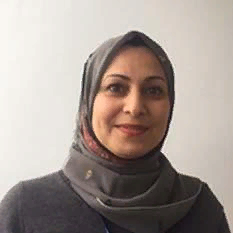
Dr. Nagham Saeed received her Ph.D. degree in optimised wireless communication networks from Brunel University, U.K., in 2012. Since 2007, Professor Nagham Saeed has been deeply engaged in the realm of electrical and electronic engineering, seamlessly integrating teaching and research. In 2011, she successfully concluded her doctoral investigation, titled "Intelligent MANET Optimisation System", at Brunel University in the UK. Her scholarly pursuits encompass both core subject research and pedagogical exploration. Her extensive research delves into the realm of intelligent systems for smart cities, wherein she designs online monitoring systems and applies artificial intelligence algorithms to drive modelling and optimisation, resulting in publications in esteemed journals across telecommunications, modelling, industry applications, information and smart power. She is also the head of the Industrial Internet of Things (IIoT) research group at her university and has actively contributed to Technical Programme Committees and Editorial Boards for many well-known international conferences and journals. Her expertise extends to reviewing and editing for top-tier international scientific publications, including submissions to IEEE conferences and MDPI journals.
Professor Nagham is recognised as a Chartered Engineer (CEng) by the Engineering Council, a senior member of the IEEE, a member of the IET and a Senior Fellow of the HEA. Her commitment extends beyond academia, assuming key roles such as the 2023 IEEE Women in Engineering UK & Ireland Chair, and she currently holds the position of Vice Chair (Chair-Elect) for the IEEE UK & Ireland Section for the term 2024-2025. She leads female IEEE members from all over the UK and Ireland, aiming to inspire the young generation.
Additionally, Nagham mentors aspiring engineers and academics who are early in their careers, while also championing the advancement of electronic and electrical engineering among young girls through diverse events and workshops. This dedication has earned her the 2021 University of West London Student Union Best Supervisor/Tutor Award and the prestigious 2022 IEEE Region 8 Outstanding Women in Engineering Section Volunteer Award.