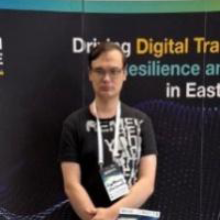
Sviatoslav Dziubenko

Work place: National Aerospace University «Kharkiv Aviation Institute», Department of Information and Communication Technologies named after O.O. Zelensky, Kharkiv, 61070, Ukraine

E-mail: garibliismayil@gmail.com

Website: https://orcid.org/0000-0002-0184-1210

Research Interests:

Biography

Sviatoslav Dziubenko is a PhD candidate at the Department of Information and Communication Technologies named after O.O. Zelensky, Faculty of Radio Electronics, Computer Systems and Infocommunications, National Aerospace University “Kharkiv Aviation Institute.” His research focuses on applying artificial intelligence in healthcare, including medical image analysis, intelligent diagnostic systems, and clinical decision-support technologies. He contributes to research projects involving neural-network-based processing of medical data and interdisciplinary work at the intersection of computer science and medicine. His academic interests include machine learning, computer vision, medical IT security, and applied software engineering for clinical environments.
Author Articles
Uncertainty-Aware Source-Free Domain Adaptation for Dental CBCT Image Segmentation

By Sviatoslav Dziubenko Tymur Dovzhenko Andriy Kyrylyuk Kamila Storchak

DOI: https://doi.org/10.5815/ijigsp.2026.01.01, Pub. Date: 8 Feb. 2026

The aim of this study is evaluating the efficacy of combining source-free domain adaptation techniques with quantitative uncertainty assessment, aimed at enhancing image segmentation in new domains. The research employs an uncertainty-aware source-free domain adaptation strategy, encompassing the generation of pseudo-labels, their filtration based on entropy and variance of predictions, alongside the involvement of an Exponential Moving Average (EMA) teacher and a tailored loss function. For validation purposes, segmentation models pre-trained on one image dataset were subsequently adapted to another dataset. A comprehensive comparative and ablation analysis, coupled with the visualization of the correlation between segmentation errors and the degree of uncertainty, was conducted. The ablation study corroborated that the complete configuration with the EMA teacher yielded the most favorable results. Data visualization elucidated a direct correlation between high uncertainty and an increased risk for segmentation errors. The findings of this study substantiate the viability of employing uncertainty assessment within the source-free domain adaptation process for clinical dentistry. The proposed methodology facilitates the adaptation of models to new conditions without necessitating retraining, thereby rendering the decision-making process more transparent. Future studies should consider assessing the efficacy of the proposed approach in additional dental visualization tasks, such as implant planning or orthodontic analysis.

[...] Read more.
Other Articles