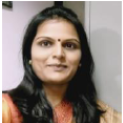
Sonali Patil
Work place: Department of Information Technology, K J Somaiya College of Engineering, Mumbai, India
E-mail: sonalipatil@somaiya.edu
Website:
Research Interests:
Biography
Dr. Sonali Patil is working as a Professor in the Department of Information Technology at K.J. Somaiya College of Engineering, Somaiya Vidyavihar University, Mumbai (India). Presently, she also owns the responsibility of Associate Dean, Academic Programmes. She received her Ph.D. in technology from the Shivaji University, Kolhapur (India) and M.E. degree in Electronics from Walchand College of Engineering, Sangli (India). She has a rich experience of over 19 years in Teaching and 1 year in Industry. She is recognized PG teacher of University of Mumbai and Somaiya Vidyavihar University. She has supervised many M.Tech students PG students in the area of information security and computer engineering. Her doctoral research was in the area of Medical Image Processing and Analysis. She is also a recognized PhD supervisor/guide of University of Mumbai and Somaiya Vidyavihar University. She has publications in peer-reviewed International Journals, Book chapters and conferences in the areas of information Security and image processing.
Author Articles
Soft Attention Enhanced CNN and LSTM Based Framework for Semantic Description Generation of Remote Sensing Imagery
By Dipti Pawade Sonali Patil Riddhi Arya Hetvi Shah Diya Bakhai Ankit Jha
DOI: https://doi.org/10.5815/ijieeb.2026.04.09, Pub. Date: 8 Aug. 2026
Remote sensing images are complex, which makes it difficult to interpret and generate semantically appropriate textual description. To get a semantically relevant description, it is important to identify complex objects and understand the contextual relationships between them. In such cases, deriving contextually accurate information while maintaining semantic coherence is challenging. Therefore, a specifically designed model architecture is required to generate semantically relevant descriptions. This paper discusses a deep learning-based approach to generate remote sensing image descriptions using an end-to-end encoder-decoder model with soft attention. The UC Merced (UCM) dataset, which contains multiple captions per image capturing various scene aspects. To further assess the robustness and generalizability of the proposed approach, its performance is additionally evaluated on more complex datasets such as RSCID and Sydney Captions. This study presents an end-to-end CNN–LSTM encoder–decoder framework enhanced with soft attention for semantic description generation from remote sensing imagery. The framework employs a VGG16 encoder to extract a 4096-dimensional visual feature vector, which is projected into a 256-dimensional representation and processed by a 256-unit LSTM decoder. The soft attention mechanism dynamically computes attention weights using the encoder features and decoder hidden state, enabling the model to emphasize relevant visual information during word generation. Multiple CNN encoders and learning rates are evaluated with LSTM decoders, both with and without attention, on the UCM, RSCID, and Sydney Caption datasets. At a learning rate of 0.0001, VGG16–LSTM with soft attention achieves BLEU-4 (B4) scores of 0.6636, 0.6636, and 0.5864 on the UCM, RSCID, and Sydney Caption datasets, respectively, compared with 0.1643, 0.1647, and 0.1745 for VGG16–LSTM without attention. The results demonstrate that soft attention substantially improves description generation by strengthening visual–linguistic alignment and enabling more contextually relevant and semantically coherent descriptions across datasets with varying scene complexity.
[...] Read more.Closed Domain Question Answering System Tailored for Crime Events Using Deep Learning for Both Statistical and Contextualized Responses
By Dipti Pawade Sonali Patil Chaitanya Bandiwdekar Siddhesh Bagwe Pooja Kaulgud Aditi Kulkarni
DOI: https://doi.org/10.5815/ijieeb.2024.04.04, Pub. Date: 8 Aug. 2024
The goal of the question-answering system is to respond to user queries expressed in natural language. Unlike search engines, the closed domain question answering systems are specialized to specific domains, providing concise and precise answers often derived from structured data. This paper focuses on a question-answering system tailored for crime events, capable of addressing both statistical and contextual inquiries. In terms of crime statistics, the fine-tuned GPT-3 model outperforms the USE, TAPAS, TAPEX, and GPT-3 models, while for context-based crime-related queries, the fine-tuned RoBERTa model surpasses the BERT and RoBERTa models. This system is capable of providing the responses in natural language format, supplemented with relevant data visualizations. The models are train on Q2A and NewsQA datasets while it is tested on NCRB and NewsTimes datasets. The Q2A and NCRB datasets are used for statistical queries while NewsQA and NewsTimes datasets are used for contextual inquiries. The paper presents an analysis of various models and showcases results for sample case studies. Such a system can prove valuable in applications where users seek to study criminal cases or gather pertinent insights for specific cases. Furthermore, it can assist in understanding patterns and trends in criminal events, particularly concerning geospatial information. Linking crime event-based question-answering systems to geospatial information facilitates exploration of niche areas and furnishes precise details about local crime with minimal hype and hence worth exploring.
[...] Read more.Other Articles
Subscribe to receive issue release notifications and newsletters from MECS Press journals